The desert has a way of stripping things down to their essence, of forcing a confrontation with silence and self. For Edward Robinson, it’s the necessary next chapter after a lifetime of noise, sparks, and the roar of a crowd. Today, August 17, 2026, marks the quiet digital release of Desert Ed, an 11-minute documentary portrait that trades the thunderous arena of competitive robotics for the vast, still expanse of the American Southwest. It’s a small film with a big emotional payload, and it arrives with the kind of intimate immediacy that only a focused, short-form documentary can deliver.
Release Date & Where to Watch
You won’t need to trek to a film festival or wait for a theatrical run to catch this one. Desert Ed premieres exclusively on OTT Stories starting today, August 17, 2026. The streaming platform, known for its curated selection of character-driven documentaries and short-form narratives, is the sole home for this piece. For the price of a subscription, you can stream the film on demand across all your devices - whether that’s on a big-screen TV, a laptop, or a phone during a commute. Given its lean 11-minute runtime, it’s the perfect midday pause or an evening palate cleanser. There’s no need to set a reminder for a live broadcast; it’s all yours, whenever you’re ready to press play. This is a direct-to-streaming release, a deliberate choice that feels fitting for such a personal and contained story - one that doesn’t need the bombast of a theatrical rollout, only the focused attention of a viewer.
Cast & Crew
At the center of this story is Ed Robinson, credited simply as Self, and that’s the core of the film’s power. He isn’t an actor playing a part; he’s a man living his life, allowing the cameras to witness a period of profound transition. Robinson is the soul, the subject, and the heartbeat of the project. Guiding the lens is director Christian Hurley, a filmmaker whose previous work has shown a keen eye for capturing the quiet dignity of people in unconventional circumstances. Hurley’s direction here is less about spectacular setups and more about patient observation, letting Robinson’s world unfold naturally. The collaboration feels less like a standard director-subject dynamic and more like a trusted partnership. Hurley was given remarkable access, and he uses it to craft a portrait that is respectful yet unflinching. The technical crew, while not named in the provided metadata, clearly understood the assignment: to make the vast, harsh beauty of the desert a character in its own right, a silent counterpoint to Robinson’s internal dialogue. This is a lean, focused team that has delivered a piece clocking in at just 11 minutes, every one of which feels essential.
Story & What to Expect
The film opens not in the desert, but with the ghost of a career. We learn of the passing of Robinson’s longtime teammate from the hit reality TV show Battlebots. That loss, a sudden severing of a partnership forged in grease, steel, and competitive fire, is the catalyst for everything that follows. Reeling from grief, Robinson makes the radical choice to leave that world behind, packing up and moving to the desert. This is not a story about building robots anymore; it’s about deconstructing a life.
Expect a contemplative, meditative experience. There are no arena battles here, no frantic pit crew repairs under a stadium's glare. Instead, Hurley’s camera lingers on the stark landscape - the parched earth, the relentless sun, the immense, star-filled night sky. The narrative is carried by Robinson’s own reflections, delivered in a low-key, direct-to-camera style that feels like a conversation with an old friend. He walks us through his past, the adrenaline of competition, the thrill of engineering a machine that can destroy another, and the profound emptiness that followed his teammate’s death. He doesn’t shy away from the hard questions: What is a career worth if the person you shared it with is gone? What happens to an identity built on violence and competition when you choose stillness?
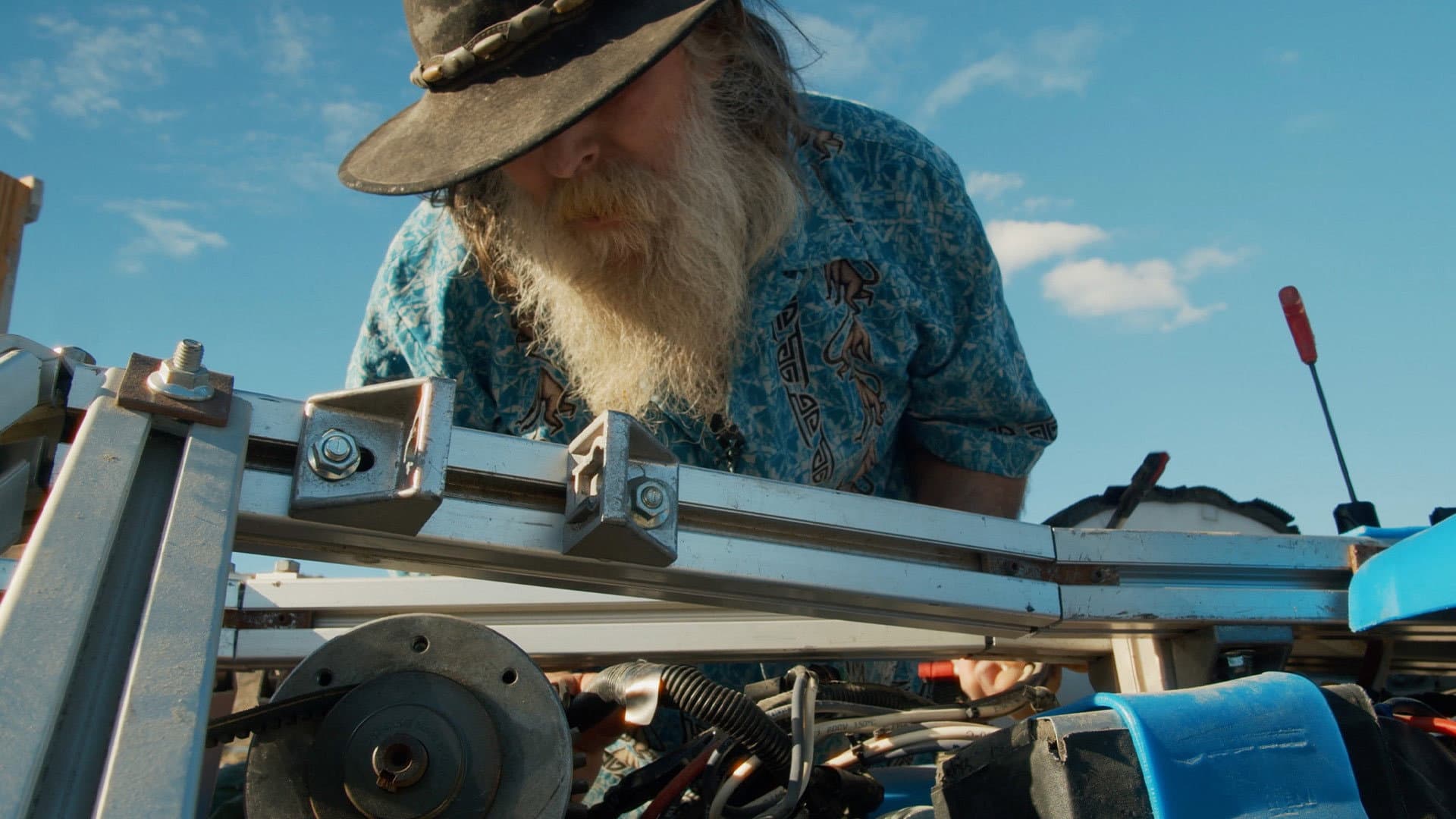
The “hermetic lifestyle” isn’t played for quirky eccentricity. It’s shown as a survival mechanism, a spiritual reset. We see him tending to a sparse garden, maintaining his modest dwelling, finding solace in the rhythmic simplicity of daily chores. The film’s power lies in its understatement. It doesn’t tell us what to feel; it simply presents a man in transition. There are moments of profound sadness, but also glimmers of a hard-won peace. The 11-minute runtime is perfect - brief enough to feel like a poem, yet substantial enough to leave a lasting impression. Don’t expect a clear-cut resolution where Robinson finds all the answers. Instead, expect a raw, authentic snapshot of a man learning to be alone, to listen, and to perhaps find a new purpose in the silence.
Why It's Worth Watching
In a media landscape dominated by loud blockbusters and serialized dramas, Desert Ed is a valuable counterpoint. It’s a quiet, human story that deserves to be seen. First, it offers a unique post-script to the pop-culture phenomenon of Battlebots, giving us a glimpse of the human cost and consequence behind the spectacle. It’s a sobering, mature look at what happens after the cameras stop rolling.
More than that, it’s a universal story about loss and reinvention. You don’t need to know the difference between a pneumatic flipper and an electric spinner to connect with Robinson’s journey. His story speaks to anyone who has ever lost a partner, a purpose, or a part of their own identity and had to figure out how to start again from scratch. Director Christian Hurley has crafted a visually stunning and emotionally resonant piece that respects its subject’s intelligence and the audience’s too.
There is no manufactured drama, no forced narrative arc. The film trusts that a man’s genuine, introspective reflection is riveting enough on its own. And it is. With a raw and vulnerable performance from Ed Robinson as himself, Desert Ed is a small gem of documentary filmmaking. It’s a reminder that sometimes the biggest battles are the ones we fight within ourselves, far away from the cheering crowds. It’s a contemplative, thought-provoking, and ultimately hopeful 11 minutes. So, take a break from the noise. Pour yourself a glass of water, put on your headphones, and go spend a few quiet moments in the desert with Ed. It’s an experience that will linger long after the credits roll.