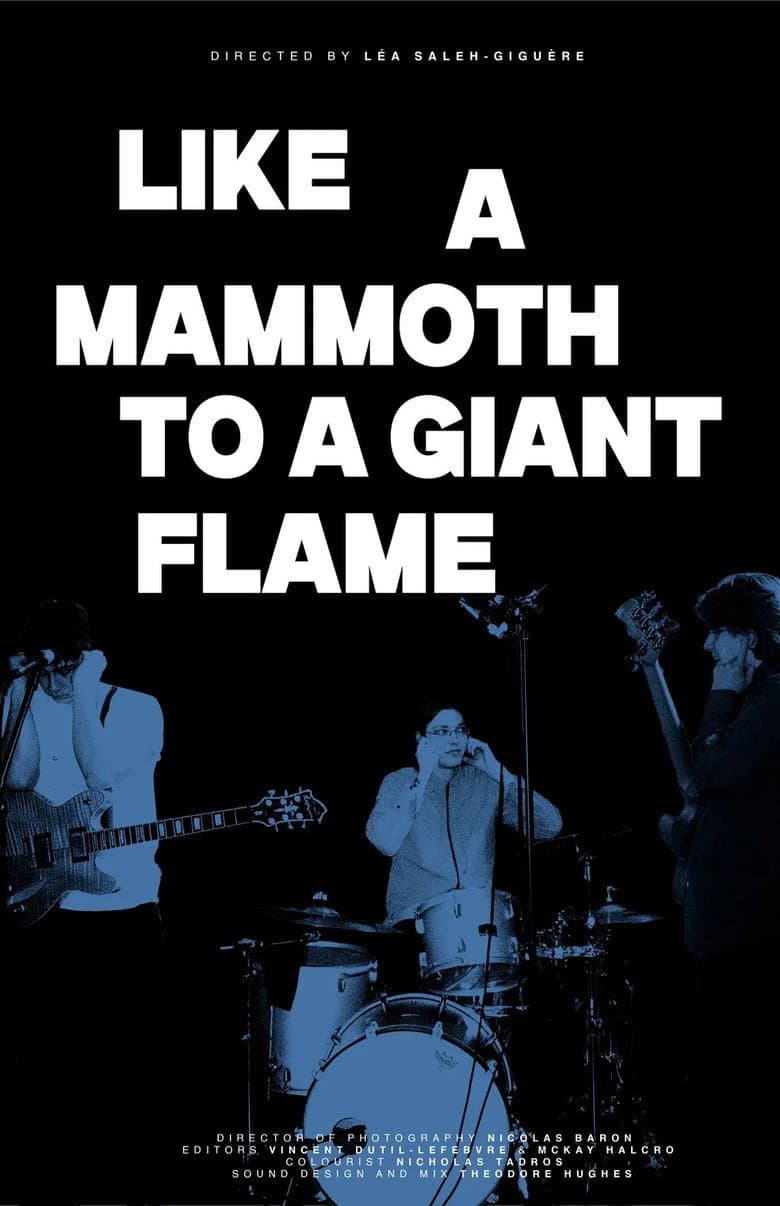
The Montreal music scene has always had a knack for producing bands that feel both deeply rooted in a specific time and place, yet strangely timeless. On August 11, 2026, a new documentary arrives that promises to capture that elusive magic, but with a twist that feels as raw and unpredictable as the music itself. Like a Mammoth to a Giant Flame isn't your standard talking-heads retrospective. It’s a 45-minute hybrid of documentary and concert film, a combustible fusion that drops viewers right into the eye of the storm with the band Mellow Casualty. This isn't a nostalgia trip; it’s a visceral, immediate experience.
Release Date & Where to Watch
Mark your calendars for today, August 11, 2026. The film officially premieres on OTT Stories, the streaming platform known for championing bold, unconventional music documentaries. You won’t need to hunt through festival lineups or wait for a limited theatrical run. The entire 45-minute experience is available to stream right now for subscribers. It’s a tight, deliberate runtime, a choice that speaks to director Léa Saleh-Giguère’s commitment to intensity over exhaustive biography. This is not a film that meanders; it hits hard and leaves a lasting mark, making it perfectly suited for the binge-friendly, immediate access of the streaming era. If you’re looking for something that cuts through the noise of typical music docs, this is your destination.
Cast & Crew
At the helm is Léa Saleh-Giguère, a director whose previous work has often explored the intersections of performance and personal identity. With Like a Mammoth to a Giant Flame, she steps into the role of both documentarian and visual interpreter. The film’s core trio is, of course, the band itself. Francois Jolicoeur appears as Himself, providing the gritty, grounded frontman energy that anchors Mellow Casualty’s sound. Ben Wood as Himself brings the textural layers, the atmospheric noise that defines their sonic palette. And Christian Couper as Himself rounds out the dynamic, offering rhythmic backbone and a palpable on-stage chemistry that is a character in its own right. The film wisely doesn’t try to turn them into actors playing characters; it relies on their authentic presence, letting their interactions and performances build the narrative. Saleh-Giguère’s camera seems less interested in conventional interviews and more attuned to capturing the unguarded moments between, during, and after the music. It’s a collaborative portrait, one that feels like it was forged in the heat of a live show rather than a sterile studio.
Story & What to Expect
The structure of Like a Mammoth to a Giant Flame is its most daring feature. There’s no linear biography here, no “we started in a garage in 2015” talking-head formula. Instead, the film weaves together electrifying, full-throttle live performances with fly-on-the-wall observational footage. You’re thrust into the sweaty, kinetic energy of a gig, watching Jolicoeur pour himself into the microphone, the strings of Wood’s guitar bending under the weight of his playing. Then, the screen shifts to a quiet van ride or a makeshift dressing room, where the three men speak candidly about their creative process, the frustrations of the industry, and the odd, instinctual pull that keeps them making music together. The title, Like a Mammoth to a Giant Flame, hangs over everything - a poetic, almost tragic metaphor for an inevitable, destructive creative drive. The film doesn’t explain the connection; it lets the juxtaposition of raw performance and quiet observation speak for itself.
Expect to feel the bass in your chest, even through a laptop screen. Saleh-Giguère’s camera work is intimate, often clustered close to the musicians, capturing the sweat, the strain, and the sheer focus in their eyes. There’s a sense of danger in the live segments, a feeling that the music could derail at any moment, which makes it all the more compelling. The documentary portions are sparse but potent, offering fleeting glimpses into the band’s dynamic without over-explaining the mythology. It’s less about telling the story of Mellow Casualty and more about capturing the essence of their existence. The film operates on feeling, on texture, on the intervals between notes and words. It’s a portrait of a band as a living, breathing organism, caught in a permanent state of becoming.
Why It's Worth Watching
In a landscape oversaturated with sanitized, career-spanning docs, Like a Mammoth to a Giant Flame feels like a welcome grenade. Its 45-minute runtime is a bold statement of intent, refusing to pad itself with unnecessary filler. For fans of Mellow Casualty, it’s an essential artifact, a captured moment of their intensity that feels both current and historically significant. For newcomers, it serves as a perfect, potent entry point - a gateway drug into a catalog that thrives on immersive soundscapes. There are no talking heads from music critics or famous collaborators here; just the band, their instruments, and the unfiltered space between them.
The film is a testament to the power of live music as a language of its own. It asks you to lean in, turn up the volume, and sit with the uncomfortable, beautiful friction of creation. It refuses to give easy answers or neat conclusions about the state of the band or the future of music. What it offers instead is a singular, hypnotic experience that lingers long after the final chord fades to black. It’s a portrait of an artist’s impulse that feels as enormous and as destined for destruction as the title suggests. For an hour, you’re not just watching a band; you’re inside their gravitational pull. That’s a rare and valuable thing, and exactly why this documentary demands your attention. The flame is burning; it’s time to watch the mammoth walk toward it.