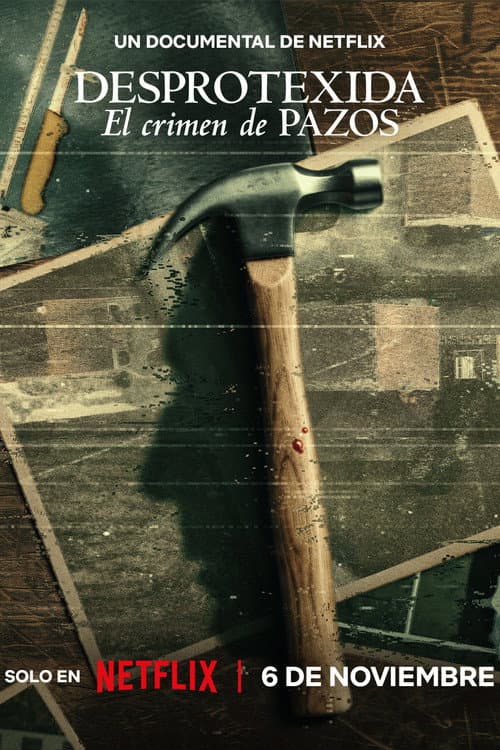
Netflix has released the official trailer for "Murder in Galicia," an 80-minute documentary that revisits a case which unsettled a small village in northwestern Spain more than a decade ago. The film, which arrives on the platform on November 6, 2026, centers on Isabel Fuentes, who was found close to death inside her own home in Pazos, a village in the municipality of Verín, in April 2015. According to the official synopsis, the attack was initially attributed to alleged burglars - but the Guardia Civil sergeant leading the investigation quickly came to doubt that explanation.
That skepticism is the documentary's emotional and narrative spine. From the outset, the sergeant in charge of the case suspected that the account of what had happened did not add up, and he attempted to shield Isabel from further harm. The trailer leans into that tension: a remote community, a version of events that never quite convinced the people tasked with examining it, and an officer who chose to keep looking. It is the kind of premise that has driven some of the most-watched true-crime documentaries of recent years, though this one is rooted in a Spanish-language production about a real Spanish case.
The project is classified as a documentary in the crime genre and is presented in its original Spanish. Netflix has not disclosed the identity of the director, and no cast members have been announced - unsurprising for a nonfiction work in which the participants are the people involved rather than actors. The film also has no audience rating yet on TMDb, where it currently sits at 0 out of 10, a figure that reflects an absence of votes rather than any critical judgment.
A Village, an Officer, and a Story That Didn't Fit
What distinguishes "Murder in Galicia" from the crowded field of streaming crime content is the emphasis its synopsis places on the investigator's early doubts. The official description does not frame the case as a whodunit for viewers to solve, but as the story of a woman whose account of her own near-fatal attack was met with suspicion almost immediately - and of the sergeant who, rather than accepting the simplest explanation, tried to protect her. That combination of institutional mistrust and personal protection gives the film a clear point of view.
The setting matters too. Pazos is a small village within Verín, a Galician municipality near the Portuguese border, and the case's local roots are central to how the story unfolded. In places where everyone knows everyone, a violent incident at a private home becomes a public reckoning, and the documentary appears to treat that intimacy as part of its subject rather than mere backdrop. The title itself places Galicia at the center of the story, signaling that the region is not incidental scenery but a defining element of the case.
The trailer's release marks the start of the film's promotional push ahead of its November 6 debut, a window of roughly two weeks. Netflix has kept specifics close - no director's name, no confirmed interviewees, no behind-the-scenes details about how the production gained access to the people closest to the case. For a documentary built on a real investigation, that restraint is itself a kind of tease, leaving audiences to discover the film's perspective when it premieres.
True Crime With a Spanish Accent
The documentary lands at a moment when true-crime nonfiction remains one of streaming's most reliable draws, and Netflix in particular has built a global audience for Spanish-language titles across fiction and nonfiction alike. "Murder in Galicia" fits that strategy: a compact, 80-minute film about a single case, told in Spanish, with a title that travels easily across markets. The genre labels - documentary and crime - position it for viewers who gravitate toward investigative storytelling, while the village setting and the officer's protective role offer something beyond the usual procedural beats.
Whether the film delivers on the promise of its premise will be clear soon enough. For now, the trailer does what a good trailer should: it establishes the facts of the case without resolving them, foregrounds the investigator's doubts, and leaves the central question - what really happened to Isabel Fuentes in April 2015 - deliberately open. The film's arrival on November 6 will give subscribers their first full look at how that question is answered, and at the portrait of a sergeant who, according to the official description, refused to accept a story that did not add up.
Source: Netflix Newsroom