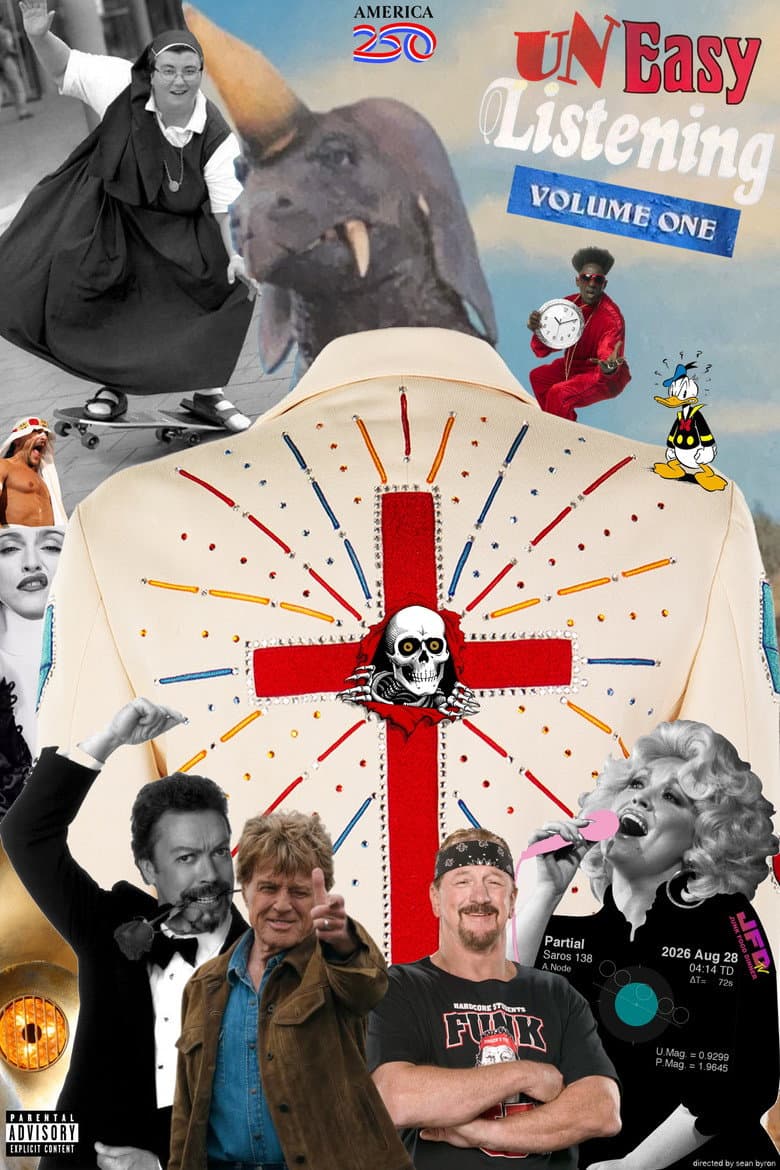
It’s a strange feeling to attend a birthday party that you know is the last one. For a nation that loves a good spectacle, the closing act of America’s 250th birthday celebration isn’t a fireworks display on the Mall, nor a parade down Main Street. Instead, it arrives with a title that sounds like a warning label: Uneasy Listening, Volume 1. Directed by Sean Byron and produced under the banner of Junk Food Dinner, this 70-minute curiosity is being positioned not as a traditional documentary, but as an audio-visual fever dream that closes the book on the Bicentennial-plus-one era. And given its title, "uneasy" feels like an understatement.
This is not the kind of film that gets a wide, studio-mandated rollout. In fact, its distribution model feels as fragmented and curious as its content. As of today, August 28, 2026, Uneasy Listening, Volume 1 is not playing in multiplexes. Instead, it has surfaced as a streaming exclusive on a platform that has built its reputation on niche, archival weirdness - OTT Stories. The service has positioned the film as a "premium event" for Labor Day weekend, which is a savvy bit of counter-programming. You can stream it starting today, with a subscription, and it is also available for a 48-hour rental window for non-subscribers. Given that the official release date was kept deliberately vague in the metadata, the "now or this weekend" urgency feels intentional. It’s a movie designed to be consumed in a single, uninterrupted sitting, ideally with the lights off and the volume turned up - just maybe not too loud.
Cast & Crew
The names attached here are the real draw, even if the cast list is a void. There are no actors to speak of, no talking heads delivering scripted monologues. The "cast" is the archive footage, and the "performers" are the DJs. On the crew side, director Sean Byron steps out from his usual role as a co-producer on various reality television experiments to take the helm. He’s a fascinating choice; Byron’s background is in structural editing, and he has a knack for turning chaotic footage into rhythmic sequences. He is joined by the sonic architects DJ Z-Trip and DJ P, two titans of the turntable who have been tasked with creating a musical score that serves as both narration and antagonist.
The production company, Junk Food Dinner, is a collective known for its abrasive, satirical takes on American consumerism. They previously produced a series of short films that re-edited corporate training videos into dystopian horror shorts. Here, they have expanded their palette. There’s no director of photography credited, which suggests the visual component is culled entirely from archival sources - news reels, home movies, and state fair promotional footage. This is a remix project, a collage piece where the "writer" is the editor. As such, the "performers" are the anonymous faces in the crowd, the politicians giving speeches, and the balloon floats slowly deflating in the rain.
Story & What to Expect
To call this a "story" is to stretch the definition of narrative. There is no protagonist, no inciting incident, and certainly no third-act resolution. Instead, Uneasy Listening, Volume 1 is a tone poem about the gap between official optimism and lived reality. The film was created to serve as the "Final Chapter" of the 250th birthday celebration, but it operates less like a commemorative retrospective and more like an exorcism.
You should expect a disorienting montage. The film opens with a pristine, high-definition shot of the American flag waving in slow motion, but the image is immediately scratched and overlaid with a distorted audio sample of a Sousa march being played backward. From there, we are plunged into a hallucinatory journey through the Bicentennial celebrations of 1976, intercut with the tech-boom optimism of the late 1990s and the digital chaos of the 2020s. The music, courtesy of Z-Trip and P, functions as a narrative spine. It moves from triumphant boom-bap to glitchy, industrial noise, often within the same sequence. There is a recurring motif of parades - specifically, the floats collapsing, the smiley-faced mascots looking exhausted as they wave to empty bleachers.
The film is deeply critical without ever being overtly political. It doesn’t name names. Instead, it makes you feel the exhaustion of the spectacle. One sequence intercuts a news anchor’s cheerful monologue about national unity with a silent, shaky home-movie of a family barbecue where the grill is on fire and everyone is arguing. The juxtaposition is darkly comic, but it lands with a heavy thud. The 70-minute runtime is lean, but it feels longer because of the density of the stimuli. It is a film that demands active concentration; if you look away for a minute, you’ll miss a visual punchline that ties the whole thing together.
Why It's Worth Watching
So, why should you subject yourself to something that sounds like a public access nightmare? Because Uneasy Listening, Volume 1 is the most honest piece of art being released this week. In a landscape of safe, algorithm-friendly content, this is a jagged, unapologetic artifact that trusts the audience to have a brain. It is a movie that understands that nostalgia is a weapon. By taking the visual language of American celebration - the bunting, the fireworks, the waving flags - and setting it to a discordant, arrhythmic beat, Byron and company have crafted a meditation on the cost of that nostalgia.
The rating is currently a goose-egg on TMDb, which speaks to its polarizing nature. Half of the audience will dismiss it as pretentious noise; the other half will likely call it a masterpiece of experimental cinema. There is no middle ground. If you are the type of viewer who enjoys the work of Adam Curtis - the way he weaves conspiracy and history into a hypnotic tapestry - then you will find much to love here, even if the tone is grungier and less didactic.
It is also worth the watch for the audio alone. DJ Z-Trip and DJ P have constructed a mix that is a technical marvel. They use the "wreck" in "wrecking crew" to full effect, creating beats that feel broken and beautiful. The final ten minutes, a slow descent into a low-frequency hum over a black screen, is audacious. It dares you to switch it off. If you stay, you are rewarded with a single, quiet whisper: "Turn it over." It leaves you hanging, an unsettling end to a party that was always going to end with a mess to clean up. It is vitally strange, and it deserves your attention - even if you have to listen through your fingers.