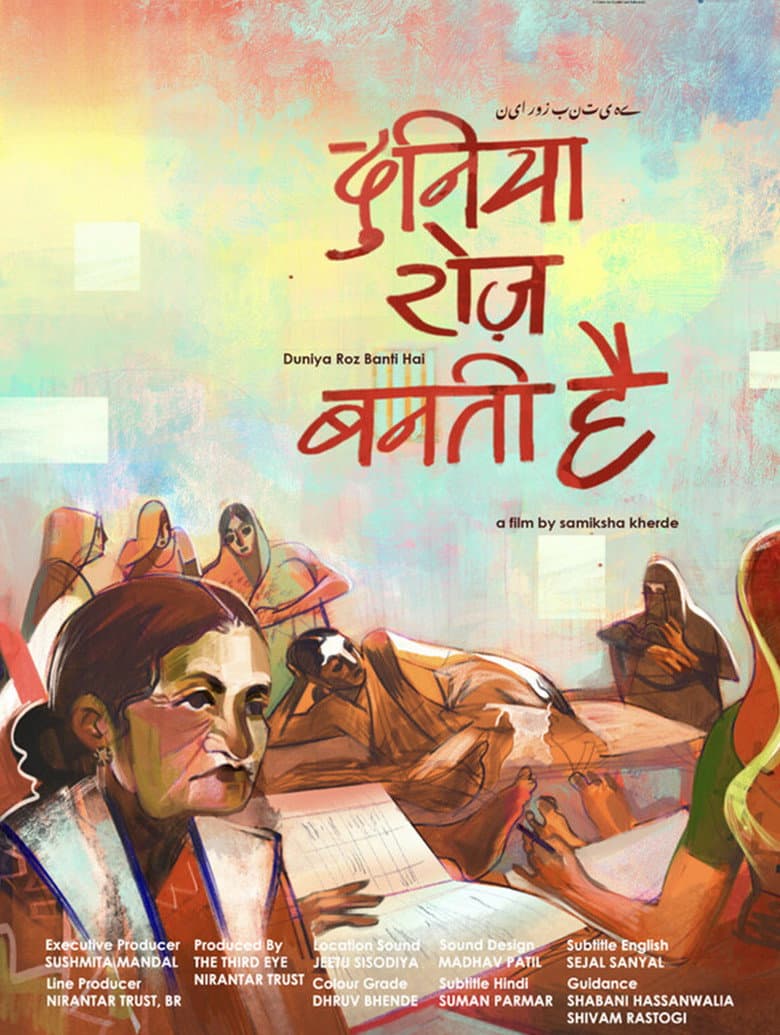
The phrase "women's court" tends to conjure something formal - a bench, a gavel, a room with a docket. Samiksha Kherde's new documentary offers something quieter and more slippery than that. In the Nari Adalats of rural Bihar, women gather to sit with disputes that their communities would rather bury, and the film simply stays with them while they listen, question, and try to untangle what cannot always be untangled. At just eighteen minutes, "A Women's Court" is brief, but its ambitions are anything but small. It arrives on OTT Stories this week, and it is the kind of documentary that rewards patience and attention.
Release Date & Where to Watch
"A Women's Court" releases on October 25, 2026, on OTT Stories. It is an English-language documentary with a runtime of eighteen minutes - short enough to fit into a lunch break, dense enough to linger well past it. The film is a Hollywood production, directed by Samiksha Kherde, and it lands on the platform with no advance audience rating to speak of; TMDb currently lists it at 0/10, which simply reflects that almost nobody has seen it yet. Consider this your chance to be early.
Cast & Crew
Documentaries of this scale rarely come with a recognizable cast, and this one is no exception - the listed cast is unknown, and that feels appropriate. The women of the Nari Adalats are not performers; they are participants, many of whom first arrived with their own disputes and now return to help resolve other people's. Their names may not be familiar, but their presence is the entire point of the film. Behind the camera, Samiksha Kherde directs a project that demands restraint above all else. There is no narrator prodding us toward a conclusion, no sweeping score to tell us how to feel. The crew keeps the footprint small, and the result is a documentary that trusts its subjects to carry the frame. It is a lean production in the best sense - the kind where the filmmaker's job is mostly to know when to stay out of the way.
Story & What to Expect
The film follows the Adalat as a space where women gather to address conflicts within their communities. That description sounds tidy; the reality is anything but. These are not mediation sessions with a neat resolution at the end of the hour. Cases can be brutal, and the film does not flinch from that. What Kherde captures instead is a process - women sitting, listening, questioning, mediating - and the slow, collective work of shaping something that resembles justice without ever pretending it is fixed or final.
Expect a documentary that resists the familiar arc. There is no triumphant verdict, no villain escorted out of the room. The Adalat offers something more honest: a space where disputes are held rather than solved, where closure is partial at best. The women who return to these courts after their own disputes were heard are the film's quiet engine - they know what it costs to bring a conflict into the open, and they know what it means to sit on the other side of that conversation. At eighteen minutes, the film moves quickly but never rushes. It observes. It lets silences do work that dialogue cannot. Viewers hoping for a tidy explainer about rural justice systems should adjust their expectations; viewers willing to sit with ambiguity will find plenty to think about.
Why It's Worth Watching
There is a particular kind of documentary that arrives without fanfare and stays with you for days. This looks like one of them. For one thing, the subject is genuinely under-seen - Nari Adalats have operated in rural Bihar for years, and yet the everyday labor of women mediating their own communities' conflicts rarely makes it to a screen of any size. For another, Kherde's approach is admirably disciplined. In an era when documentaries often feel the need to argue, this one prefers to witness. The film's refusal to hand down a verdict is not a weakness; it is the thesis. Justice, as the film presents it, is not a ruling but a practice - something shaped slowly, collectively, and without clear closure. That insistence on process over resolution makes for an unusually mature piece of nonfiction filmmaking. And at eighteen minutes, it asks very little of your evening and a great deal of your attention. The two are not the same thing, and "A Women's Court" understands the difference. Release day is October 25. Put it on your list - and bring your patience.