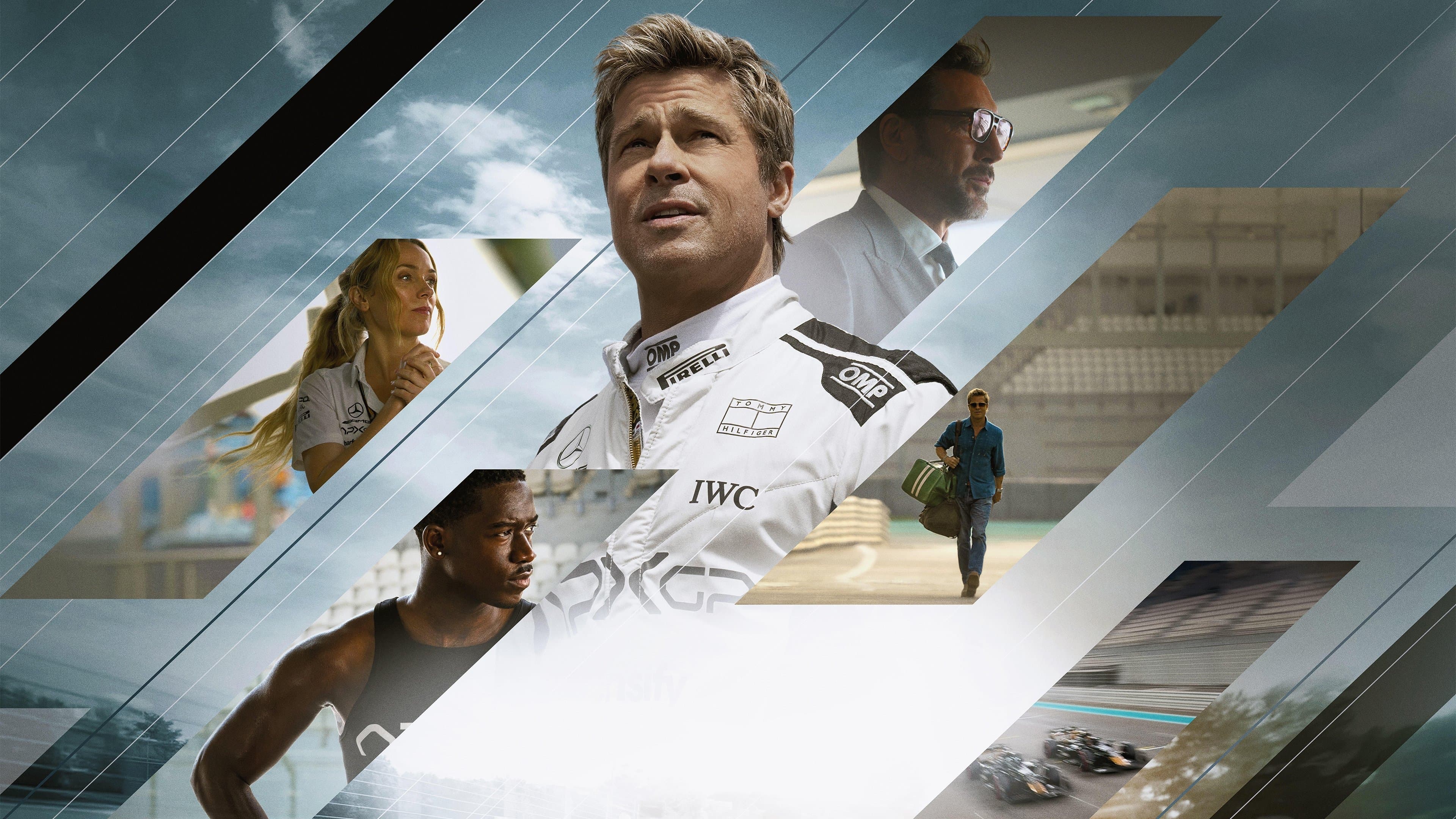
There is a moment in Joseph Kosinski's F1 where the roar of the engines fades, and all you hear is the ticking of a clock. It’s a clever bit of sound design in a film that is otherwise defined by its noise - the screaming V6s, the screeching tires, the deafening roar of a crowd willing a legend to defy physics one last time. But that silence is the heartbeat of the movie. It reminds us that time is the only opponent Sonny Hayes can't out-drive.
Released last summer, F1 arrives on streaming this week, offering those who missed it on the big screen a chance to experience one of the year’s most visceral rides. The premise is classic sports drama: a fallen icon is pulled back into the fray for one final shot at redemption. But in the hands of Kosinski, who turned Top Gun: Maverick into a masterclass of practical spectacle, the familiar beats feel fresh, urgent, and surprisingly emotional.
Brad Pitt stars as Sonny Hayes, a driver whose career was cut short decades ago by a crash that would have ended lesser men. Now, he’s living a nomadic existence, racing in obscure circuits, a ghost haunting the edges of the sport he once dominated. Enter Ruben Cervantes (Javier Bardem), an old friend and the owner of a struggling Formula 1 team, who makes Sonny an offer he can’t refuse: come back, lead the team, and mentor a rookie hotshot named Joshua Pearce (Damson Idris).
What follows is a fascinating study in generational friction. Pearce is young, gifted, and infuriatingly confident - a digital native raised on simulators and data who sees racing as a science to be solved. Sonny, by contrast, is analog. He feels the car, reads the track, trusts his gut. Their dynamic is the film’s engine, and Pitt and Idris spark off each other with a prickly chemistry that evolves into something genuinely moving.
Kosinski doesn’t shy away from the technicalities of the sport. The film is steeped in the language of Formula 1 - DRS zones, tire degradation, pit strategy - but it never loses sight of the human story. The racing sequences are shot with a you-are-there intimacy that puts you in the cockpit, the camera mounted so close to the drivers’ helmets that you can see the sweat beading on their brows. Cinematographer Claudio Miranda, a frequent Kosinski collaborator, captures the sport’s dangerous beauty: the blur of the barriers, the kaleidoscope of liveries, the way a car can seem to dance on the edge of disaster.
At 156 minutes, the film takes its time. Some might argue it lingers too long on the team’s internal politics, particularly the subplot involving Kate McKenna (Kerry Condon), the team’s pragmatic technical director, whose skepticism of Sonny slowly gives way to respect. But that patience pays off in the final act, which builds to a climax that is as emotionally satisfying as it is thrilling.
At its core, F1 is a film about legacy. What does it mean to be remembered? Is it worth risking everything for one more lap, one more win, one more chance to feel alive? Sonny Hayes is a man out of time, but he’s also a man who refuses to be defined by his past. Pitt plays him with a weary grace, his eyes carrying the weight of decades of regret and unfinished business. It’s a quiet, understated performance in a film that often roars.
The supporting cast is uniformly excellent. Bardem brings a warm, weary charm to Cervantes, a man who has bet everything on a dream that might not pay off. Tobias Menzies is suitably icy as Peter Banning, a rival team principal, and Kim Bodnia provides some welcome levity as Kaspar Smolinski, Sonny’s loyal mechanic. But the film belongs to Pitt and Idris, whose relationship forms the emotional core of the story.
With a TMDb rating of 7.8/10, F1 has clearly resonated with audiences. It’s not hard to see why. In an era of CGI spectacle, there’s something deeply satisfying about a film that feels so physical, so tangible. You can almost smell the gasoline.
As the credits roll and the engines fade, you’re left with a simple truth: some stories never get old. The quest for redemption, the need for speed, the thrill of the race - they speak to something primal in us all. F1 understands that. It’s a crowd-pleaser, yes, but it’s also a reminder that even the fastest among us are just chasing the same things we all are: a second chance, a shot at glory, a moment that lasts forever.